
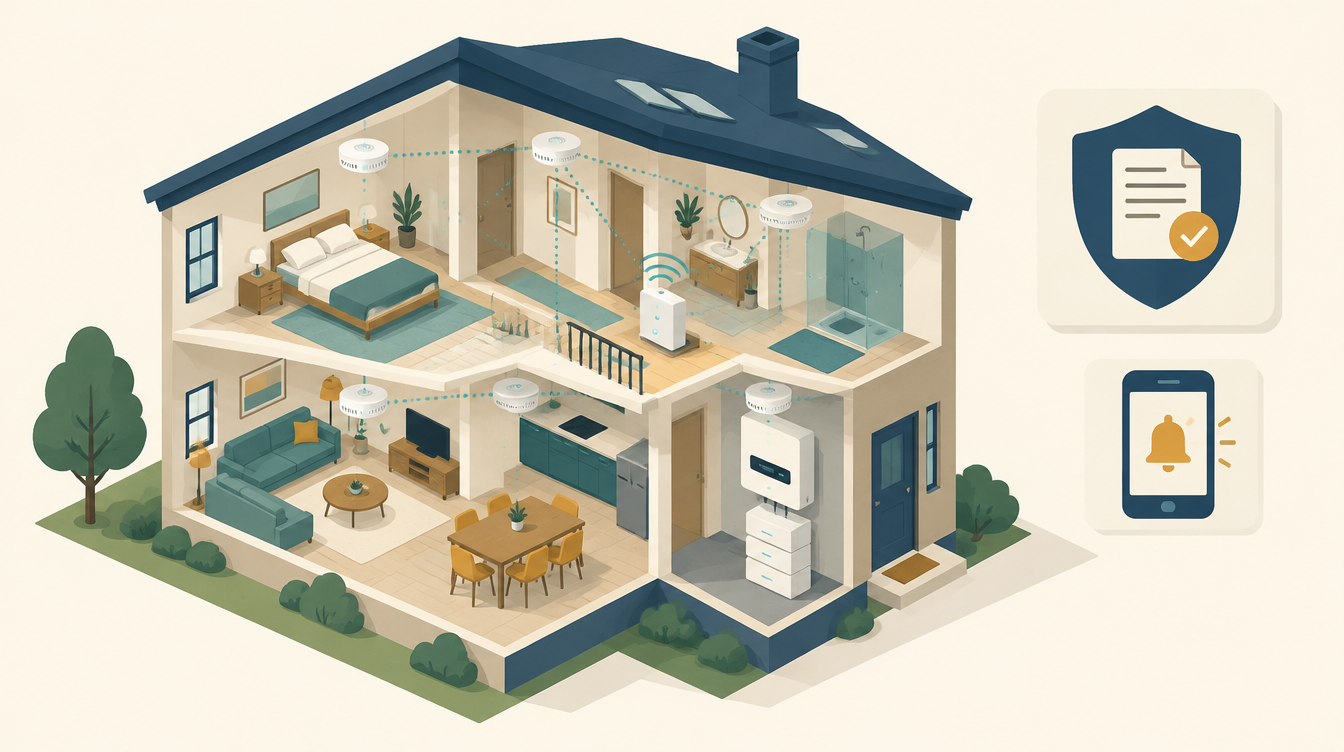
A home battery of just over 30 kWh is a nice buffer, but also something to take seriously. Home battery fire safety comes down to three things: having the battery installed properly, reporting it to your insurer and making sure you notice a fire straight away. I sorted that last one with six wirelessly interconnected X-Sense smoke alarms, one of which hangs next to the battery. Below you can read what I did and why.
The short answer: report your home battery to your insurer, fit a smoke alarm in the room where the battery is, and choose alarms that are connected to each other. Then the alarm goes off everywhere in the house, even if the fire starts in a room you rarely visit.
How big is the fire risk of a home battery?
Small, but not zero. The Netherlands Institute for Public Safety (NIPV) researched home batteries and fire safety. The conclusion: if things go wrong, a battery fire can grow quickly and is hard to extinguish. There are no Dutch or European regulations yet that focus specifically on the fire safety of home batteries.
The type of battery matters. My Dyness Stack 100 uses LFP cells (lithium iron phosphate). They are much less violently flammable than the cells in, say, an e-bike battery. But the Dutch fire service (Brandweer Nederland) points out that they can produce a lot of smoke when there is a fault. And smoke is exactly what a smoke alarm picks up early.
According to the fire service, the biggest risks are not with permanently installed systems, but with plug-in batteries and DIY builds. What helps for every home battery:
- Have it installed by a qualified installer. Work on 230/400 V is not a job for a Sunday afternoon, and insurers often exclude installation errors.
- Choose a dry, cool, ventilated spot. No boxes, paint or flammable items up against the battery.
- Not in the escape route. A battery in the hall or under the stairs sits exactly where you need to pass if things go wrong.
- A smoke alarm in the same room. More on this below.
Home battery and insurance: always report it
A home battery is not automatically covered. The Dutch Association of Insurers (Verbond van Verzekeraars) warns about this itself: every insurer sets its own requirements for installation, reporting, maintenance and documentation. Broadly speaking (in the Netherlands):
- A permanently installed battery usually falls under the buildings insurance.
- A loose or plug-in battery is more likely to fall under the contents insurance.
- Damage caused by installation errors, DIY builds or poor maintenance is often excluded.
- A faulty battery without a fire is rarely covered. That is what the manufacturer’s warranty is for.
I reported my home battery to my insurer. That was quickly sorted: no extra requirements were added. That may not be the case with your insurer. Univé, for example, explicitly recommends a smoke alarm in the room with the home battery and annual maintenance.
What you want to have to hand when reporting it, and keep afterwards:
- brand, type and capacity of the battery and the inverter;
- the installer’s invoice and handover document;
- the place in the house where the battery is;
- the insurer’s confirmation, on paper or by email.
Not sure whether a battery pays off for you at all? Run the numbers first with the home battery calculator (in Dutch). Then treat the insurance as a fixed part of the purchase.
Smoke alarms: what is mandatory?
Since 1 July 2022, every home in the Netherlands must have at least one working smoke alarm on every floor, in the escape route (hall or landing). This is set out in the Dutch Living Environment Buildings Decree (Besluit bouwwerken leefomgeving). The fire service also recommends extra alarms, including in the living room, near the washing machine and dryer, and in places where batteries are charged. The fire service also mentions interconnected alarms as extra protection.
Those last two tips came together for me. A home battery is often in a utility room, garage or scullery: places where you are not all day. You might not hear a standalone alarm there if you are asleep upstairs. That is why I wanted alarms that warn each other.
My smoke alarm system: six interconnected X-Sense alarms
I bought an X-Sense set: FS61 smoke alarms with an SBS50 base station. There are six of them: in all the large rooms, in the hall and in the utility room next to the home battery. I am really happy with them.
The beauty is in the interconnection. The alarms are wirelessly connected to each other. If the alarm next to the battery detects smoke, all six go off. So I also hear it in the bedroom, far from the utility room. The base station is on the Wi-Fi and sends a notification to the X-Sense app on my phone. If I am not at home, I still know.
Alarm utility room ────────┐
Alarm hall ────────────────┤  wirelessly linked:
Alarm living room ─────────┤  one alarm sees smoke,
Alarm kitchen ─────────────┤  all six go off
Alarms other rooms ────────┘
          │
          ▼
SBS50 base station ── Wi-Fi ──> X-Sense app
                          └──> Home Assistant
What else I like about it:
- No wiring. The alarms run on a battery. Mounting them is a matter of a few screws per alarm.
- Overview in the app. You see the status and battery level of each alarm, without standing on a ladder.
Whatever smoke alarm you buy, check for the EN 14604 mark. That is the European standard for smoke alarms in homes.
The smoke alarm next to the home battery
For the alarm in the utility room, I paid attention to a few things. These tips come largely from the fire service’s placement advice.
- On the ceiling, because smoke rises. At least 50 cm from walls and corners.
- Not right in an airflow, such as a ventilation grille or the air outlet of the inverter. A draught blows smoke away from the alarm.
- Keep an eye on dust and vapour. If the room is dusty or damp (think of a tumble dryer next to it), a smoke alarm can give false alarms. A heat alarm is an alternative there, although it responds later.
- Check the range. A utility room is often behind thick walls or in a basement. After mounting, test whether the alarm reaches the base station properly.
X-Sense in Home Assistant
The alarms are also in Home Assistant, through an integration. That way I also see the alarms and their status on my dashboard, and the smoke alarm system falls under the same monitoring as the rest of my house.
One thing I find important: Home Assistant is an extra layer here, not a requirement. The alarms sound by themselves and warn each other by themselves. If Home Assistant goes down, or the internet, the alarm in the house simply goes off. That fits how I set up the rest of the system: critical functions must not depend on a single link.
What Home Assistant adds is what happens around the alarm. An example of an automation: when there is smoke, you get a critical notification that breaks through your phone’s silent mode, and the lights turn on so the escape route is lit.
automation:
  - alias: "Smoke detected: warn and turn lights on"
    triggers:
      - trigger: state
        entity_id:
          - binary_sensor.rookmelder_technische_ruimte_smoke
          - binary_sensor.rookmelder_hal_smoke
        to: "on"
    actions:
      - action: notify.mobile_app_mijn_telefoon
        data:
          title: "Smoke alarm"
          message: "Smoke detected: {{ trigger.to_state.name }}"
          data:
            push:
              sound:
                name: default
                critical: 1
                volume: 1.0
      - action: light.turn_on
        target:
          area_id:
            - hal
            - overloop
Adjust the entities, the notify service and the areas to your own installation. The critical setting works on iPhone; on Android you use the alarm_stream notification channel for this. How I write automations like this and have them checked, you can read in How I use Claude for Home Assistant.
Want to monitor break-ins in Home Assistant as well as smoke? How to build an alarm system with Home Assistant with door and window contacts, a siren and Alarmo is in a separate post.
My checklist for a safe home battery
- Battery installed by a qualified installer, with a handover document.
- Dry, cool spot, not in the escape route, nothing flammable against it.
- Reported to the insurer, confirmation kept.
- Smoke alarm in the room with the battery.
- Alarms interconnected, so the alarm goes off throughout the house.
- Notification on your phone when you are not at home.
- Test every month or via the app, and keep an eye on the alarms’ battery levels.
Frequently asked questions
Do I have to report my home battery to my insurer?
Yes. Most insurers want you to report a home battery, and it is not automatically covered. Report it before or straight after installation and keep the confirmation.
Is a smoke alarm next to the home battery mandatory?
In the Netherlands, the law only requires one smoke alarm per floor in the escape route. An alarm in the battery room is advice from the fire service and insurers. Some insurers make it a condition, so check your policy.
Is an LFP home battery fire safe?
LFP batteries are a lot less violently flammable than other lithium-ion batteries. But no battery is risk-free, and a fault can release a lot of smoke. A smoke alarm nearby remains sensible.
Does the alarm go off if the internet or Home Assistant fails?
With my X-Sense alarms, yes. They sound by themselves and warn each other by themselves. Without internet you only miss the notification on your phone and the automations in Home Assistant.
What I use
- X-Sense FS61 smoke alarms with SBS50 base station: wirelessly interconnected smoke alarms with an app. I have six, one of which is next to the home battery.
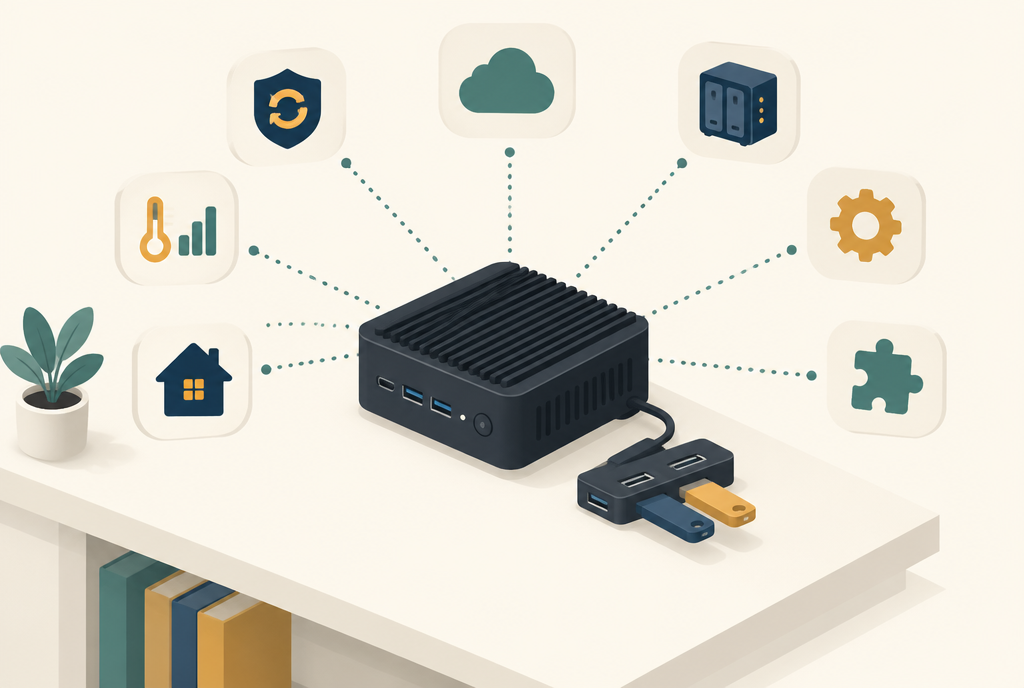
- MeLE Quieter 4C mini PC: this runs Home Assistant, including the smoke alarm automations.
This article contains affiliate links. As an Amazon Associate I earn from qualifying purchases. The price stays the same for you.
This works in my situation: a permanently installed Dyness Stack 100 on a Deye inverter in a utility room, reported to my insurer without extra requirements, and six interconnected X-Sense smoke alarms that are also in Home Assistant. Insurance terms differ per company and per policy. Check it against your own documentation and policy terms; leave work on 230/400 V to a qualified electrician. Status: October 2026.


Leave a Reply