
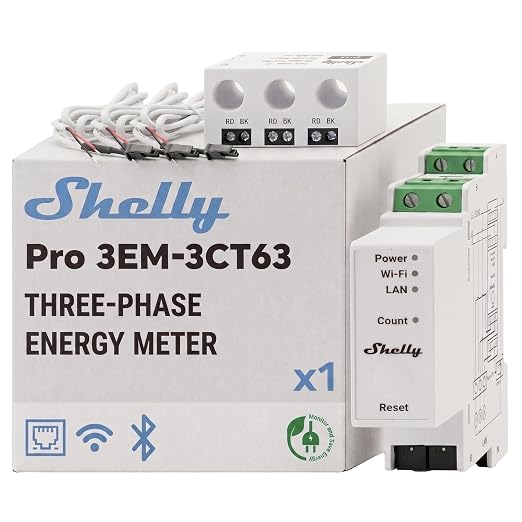
I measure my heat pump’s electricity use with a Shelly Pro 3EM on the outdoor unit’s 3-phase circuit. In standby it showed a believable 136 W. But as soon as the compressor ran, the Shelly Pro 3EM showed negative power. The Shelly was not broken, and a minus sign in software was not the fix.
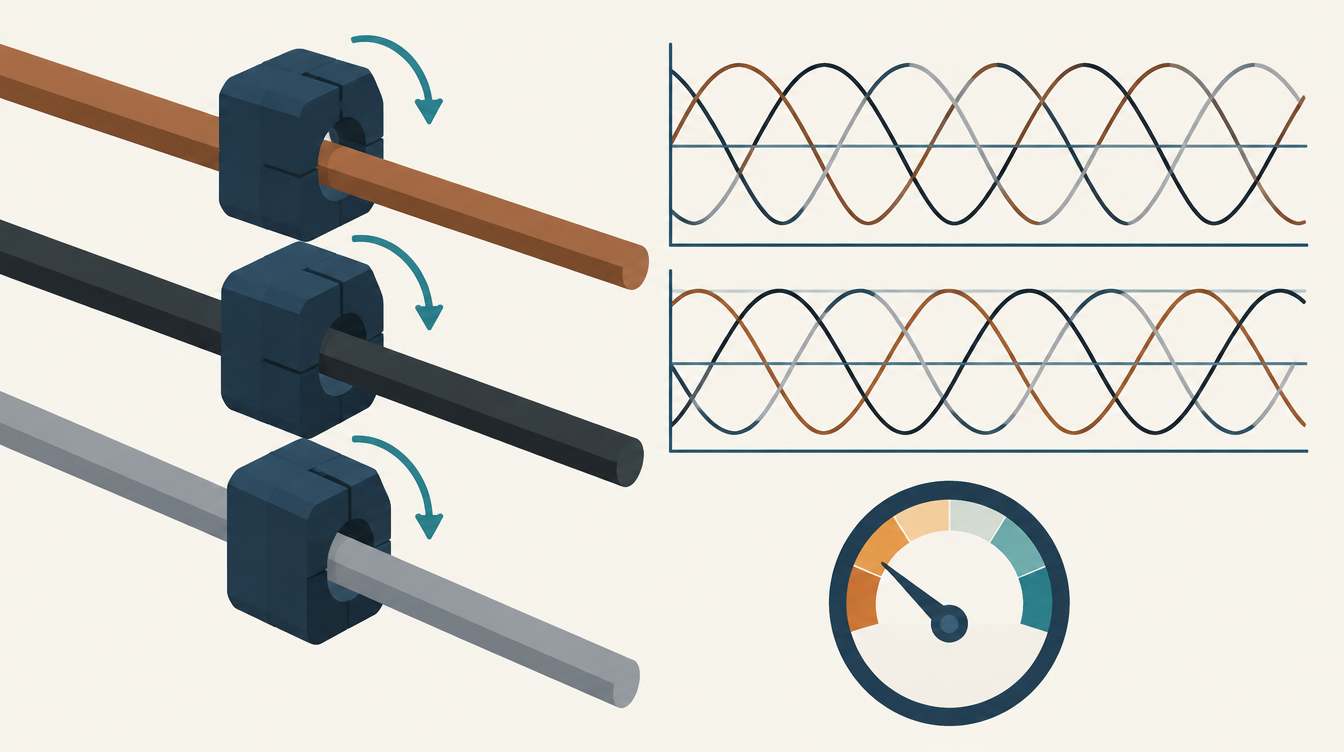
The cause: clamps on the wrong phase
A three-phase meter calculates the power per phase from that phase’s voltage and the current through the matching clamp. If clamp A sits around the phase B cable, the meter compares a current with a voltage that is shifted by 120°. In my case all three clamps were moved one position along: cyclically shifted.
In standby you don’t notice. Mostly reactive current flows then (about 0.22 A per phase in my case), and the 136 W was apparent power; the real figure was a few watts. Only under load does the error become visible.
How to check your Shelly Pro 3EM for negative power
Look at the power factor per phase while the device draws at least 1 kW:
| Power factor under load | Meaning |
|---|---|
| +0.85 to +1.0 | Connected correctly |
| about −0.5 | Phases swapped (clamp on the wrong phase) |
| about −1.0 | Clamp reversed around the cable |
If all three phases are around −0.5, the clamps are probably cyclically shifted, and moving them one position along fixes it. After the correction, all phases showed positive power under load in my case, with a power factor around 0.85.
Never fix this by multiplying by −1 in software. With swapped phases, not only the sign is wrong, but the magnitude too. And leave moving current clamps in a consumer unit to a qualified electrician.
The aftermath
- The COP was too high. The negative power was clamped to 0, so too few kWh were counted. I restarted the COP measurement on seasonal meters with a reset button.
- The Shelly’s export counter still shows a few kWh from the period with swapped phases. I don’t use it anywhere.
- Even when connected correctly, it measures around −8 W in standby, with a power factor of about 0. That is measurement noise on reactive current at the bottom end of a 63 A clamp. Clamp calculations to 0 W.
More about measuring: Measuring and calibrating. All incidents: Lessons from practice (in Dutch).
This article contains an affiliate link. As an Amazon Associate I earn from qualifying purchases. The price stays the same for you.
These values apply to one installation. Check them against your own documentation; leave work on 230/400 V to a qualified electrician.




Leave a Reply